2026
Tracewell
Mission control for AI agents — see every step, stop the risky ones.
Mission control for AI agents: replay every run as a step-by-step trace, catch cost spikes and failures, and approve risky actions before they execute.
A self-initiated concept, designed like a real product.
The brief we set ourselves
Design an observability console for AI agents in production: replay any run step by step, catch cost spikes and failures early, and let a human approve risky actions before they execute.
Who it is for
AI and ML engineers who debug agents, ops people who watch them, and product owners who answer for their cost and their mistakes.
What we designed
Runs overview with KPIs and anomalies, a trace replay of a failed run, an approval queue for paused actions and cost & token analytics with budgets.
Design facts from the concept files — not business results.
02ResearchAgents fail quietly. The console should not.
We checked how fast the agent market grows, why so many agent projects are expected to be cancelled, and how open-source LLM observability presents traces — then designed the human layer on top.
We checked how fast the agent market grows, why so many agent projects are expected to be cancelled, and how open-source LLM observability presents traces — then designed the human layer on top.
- Market
The AI agents market was estimated at $7.84B in 2025, growing to $52.62B by 2030 (CAGR 46.3%).
DecisionDesign for agents in production, at volume: 6,214 runs a day, filters and anomalies — not a playground for one prompt.
- Risk
Gartner expects over 40% of agentic-AI projects to be scrapped by the end of 2027 — because of costs, unclear value and weak risk controls.
DecisionMake cost and control first-class: spend per run on every row, budgets with alerts, and an approval queue with a countdown to auto-deny.
- Momentum
Product Hunt re-organised its awards around categories that include AI automation builders and coding agents.
DecisionThe audience is broad — so labels stay plain («Failed at step 6», «Why it was paused») and the engineering detail lives one click deeper.
Patterns we borrowed
- Langfuse
- Only the core idea of LLM traces as a tree of spans; no screens or visuals audited or reused
- APM tools
- A span waterfall with timings next to the tree
- Code review
- A diff view for the request body and for an edited tool call
- Video players
- A replay scrubber with step markers and Prev / Next
What we left out
Names, logos and screens of Langfuse or any observability vendor. Tracewell has its own name, mark and backdrop renders; the models in the screens are fictional («orion-l»).
Moodboard references
From a log dump to a run you can replay.
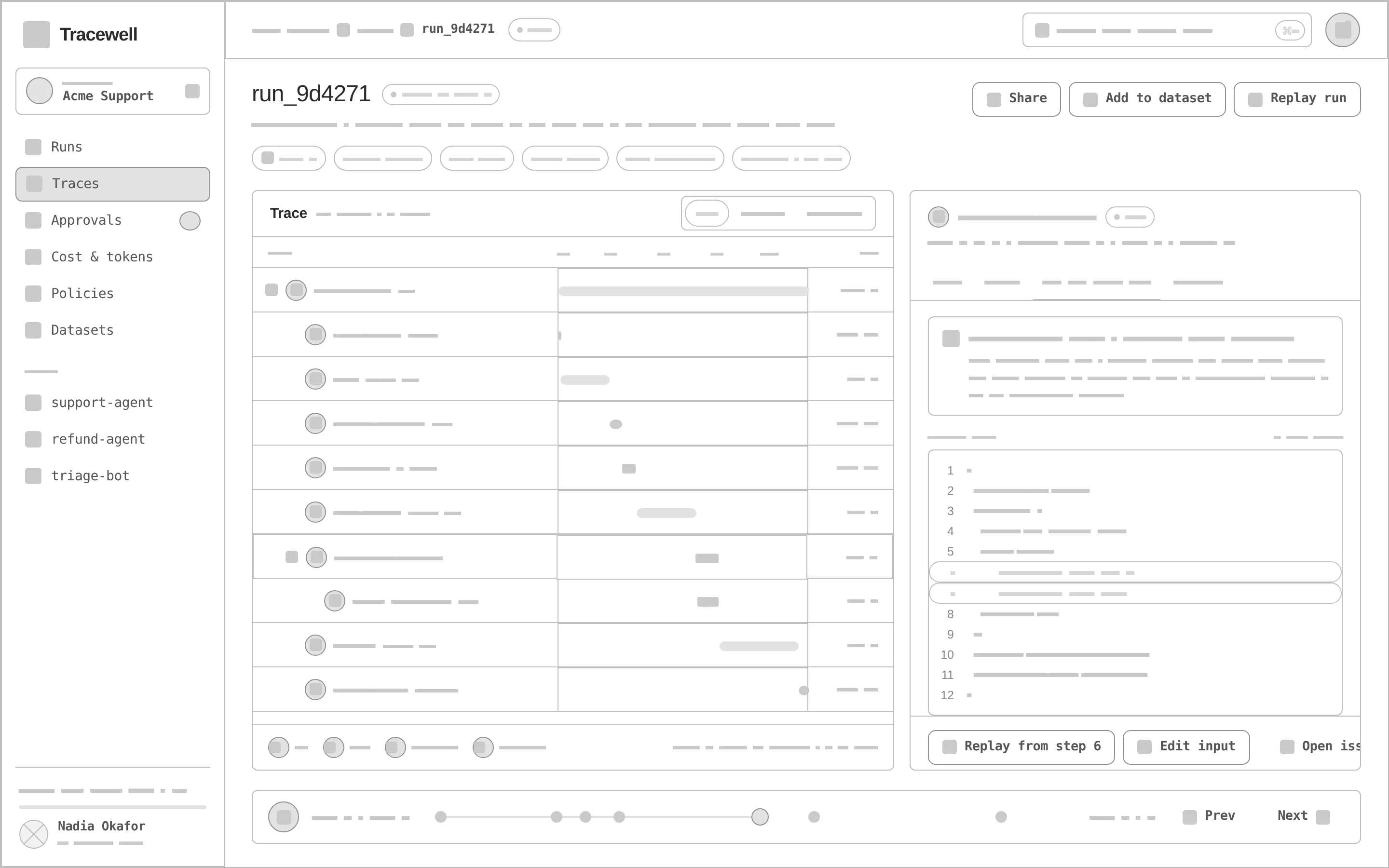
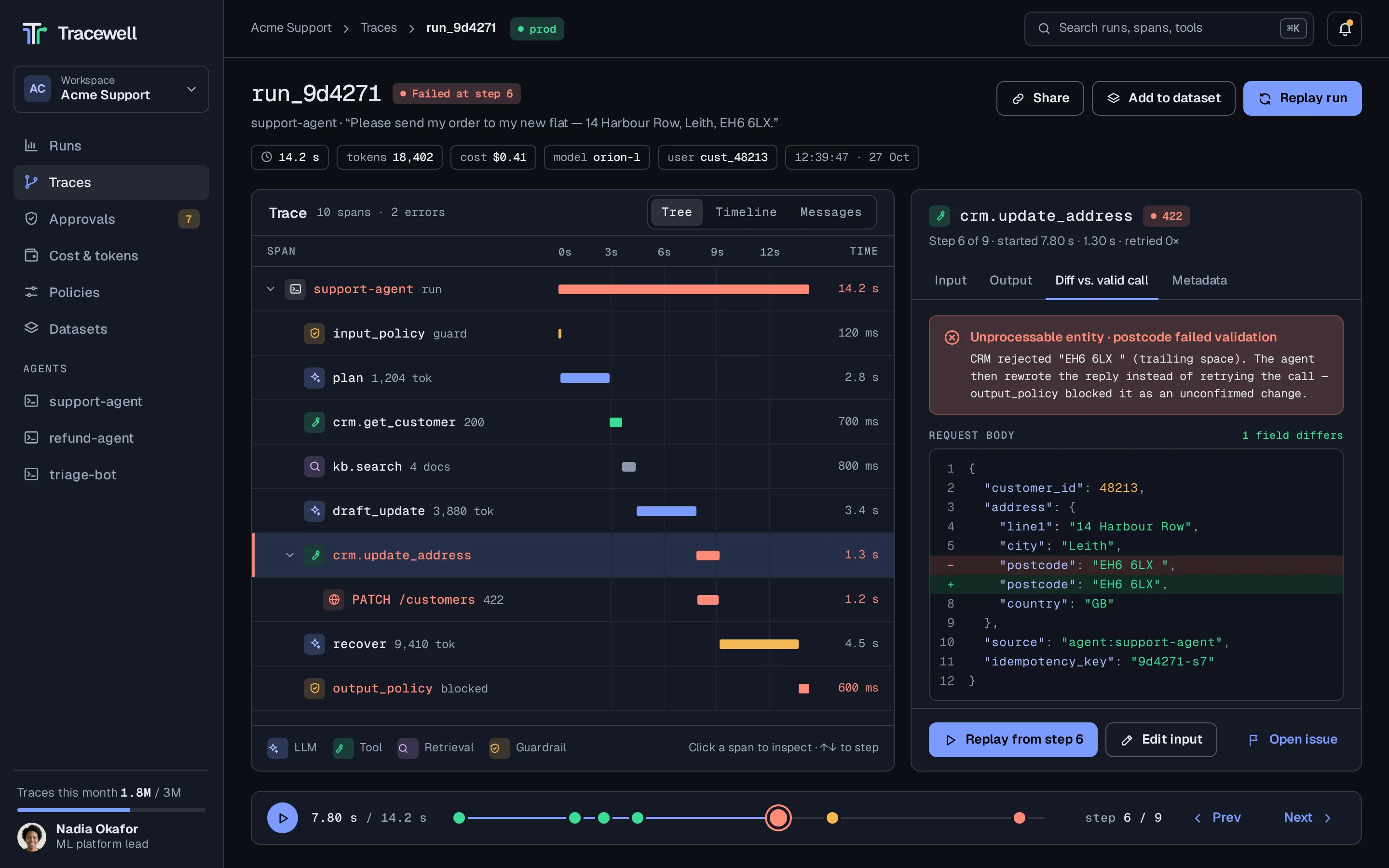
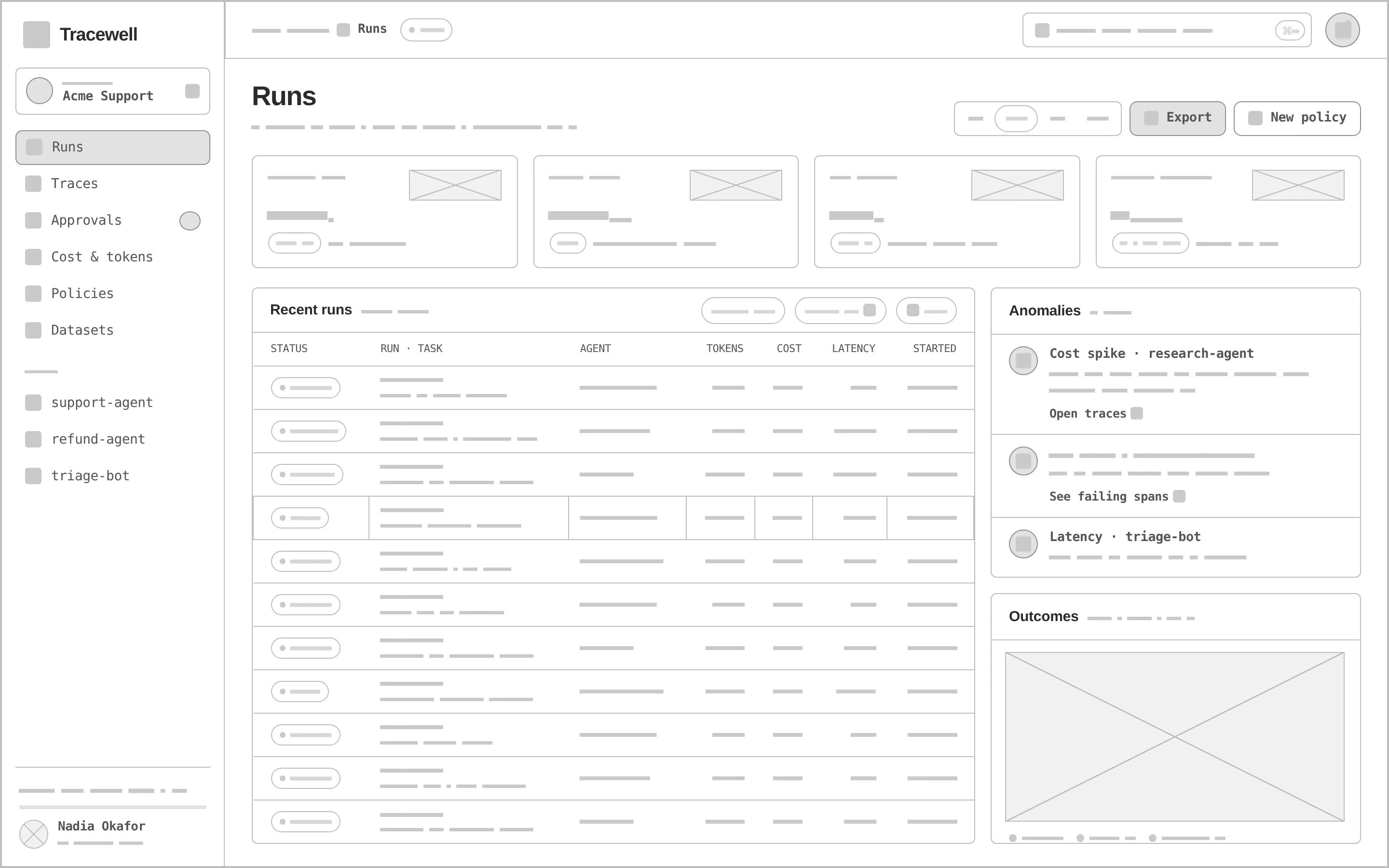
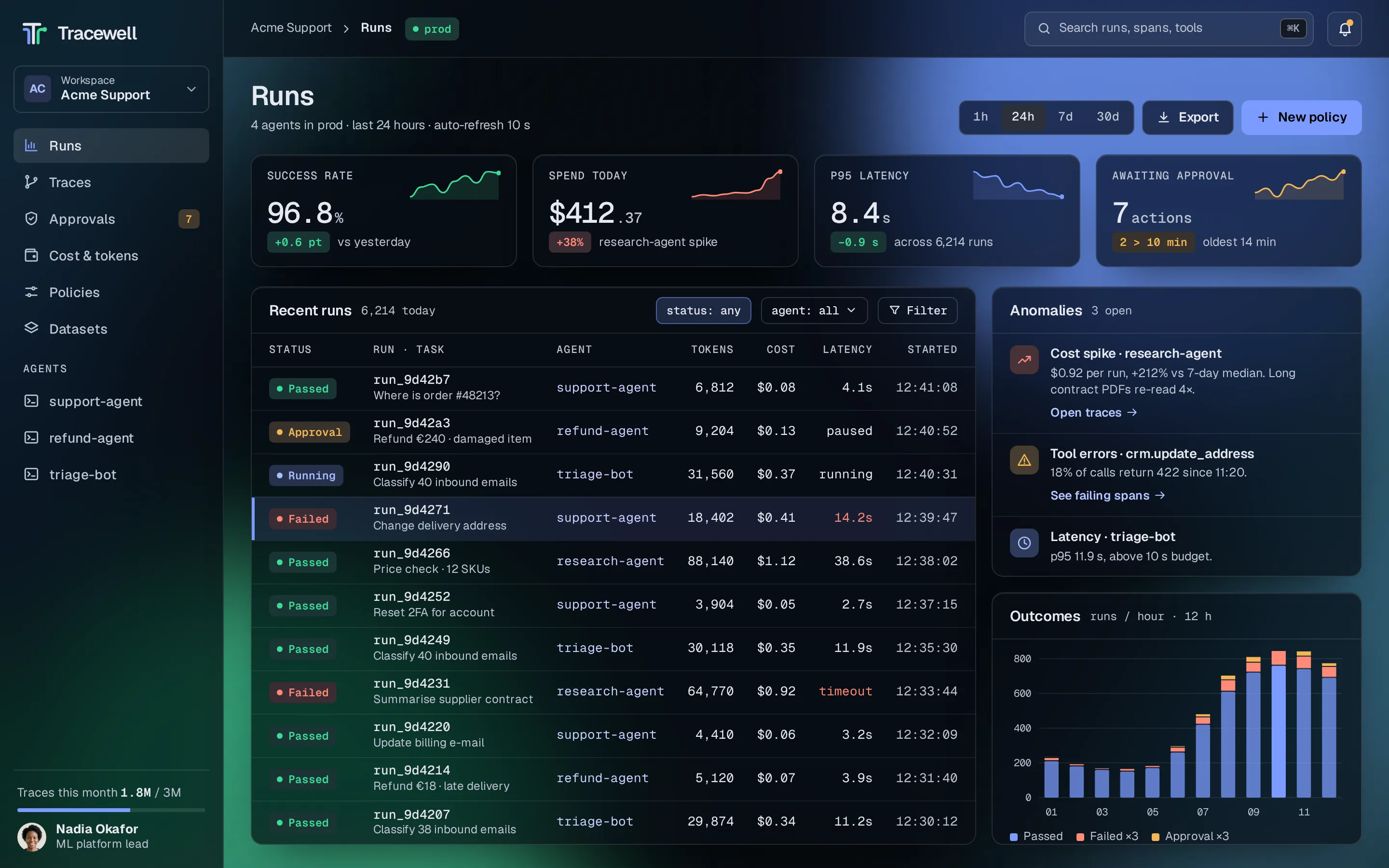
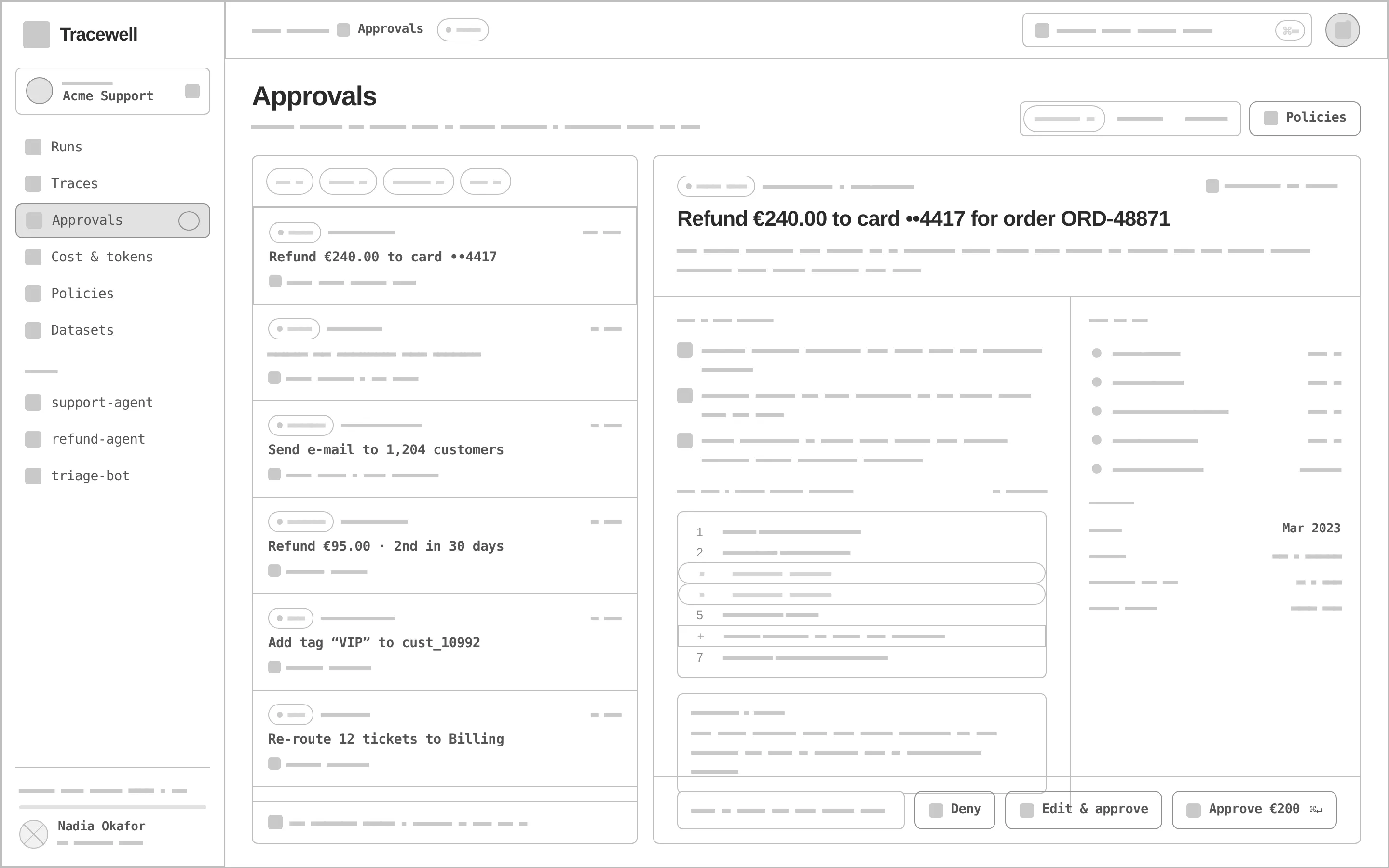
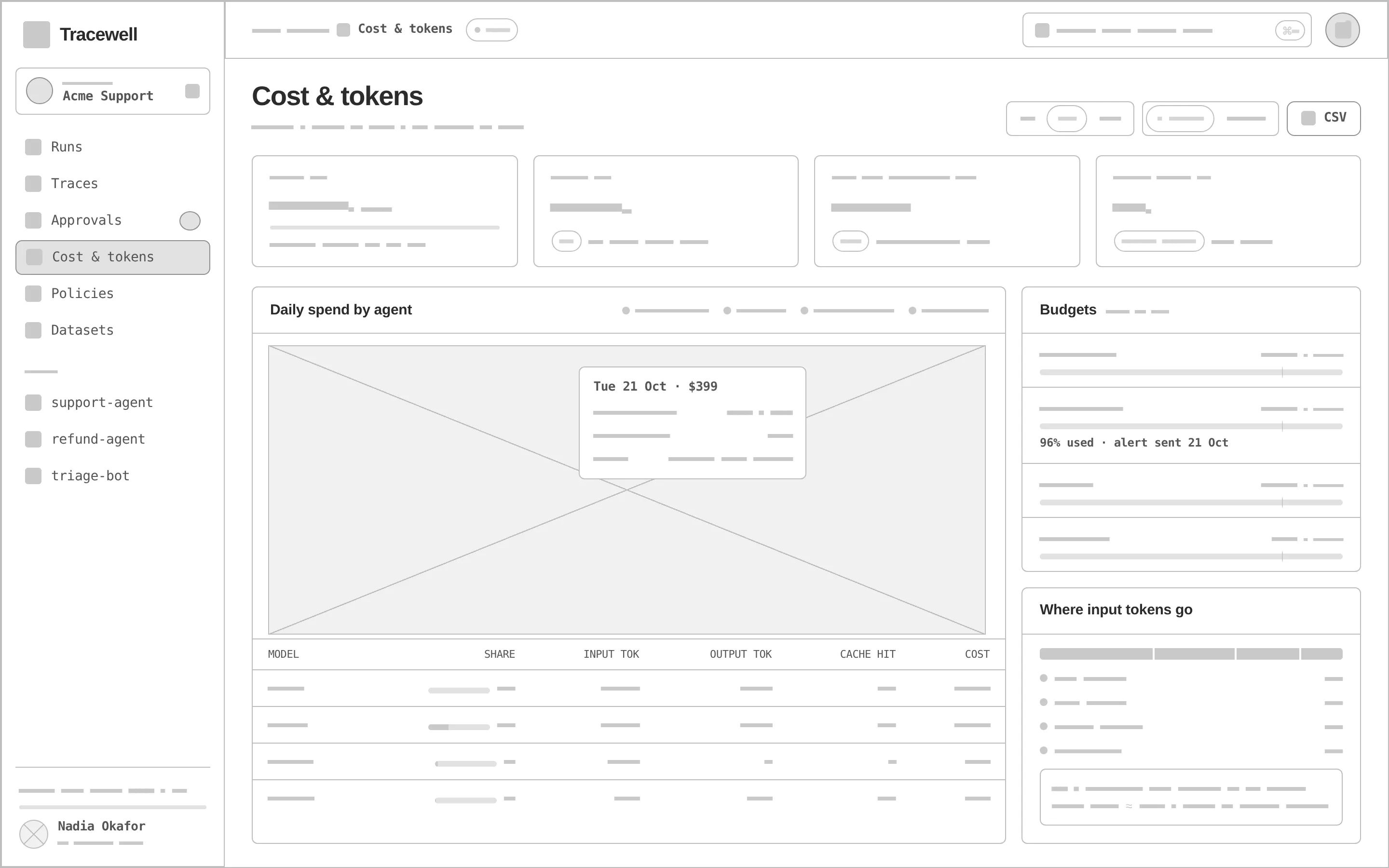
Every «before» is generated from the very same screen markup, reduced to outlines, readable labels and grey word-bars — no colour, glass or backdrop. Drag the handle to compare.
- 01
Hierarchy
The failure first: «Failed at step 6» next to the run id, the failing span highlighted in the tree, the error explained in a sentence before the JSON.
- 02
Grid & density
A 236 px sidebar and a dense canvas: tight span and table rows in mono where engineers scan, wide cards with plain sentences where humans decide.
- 03
States
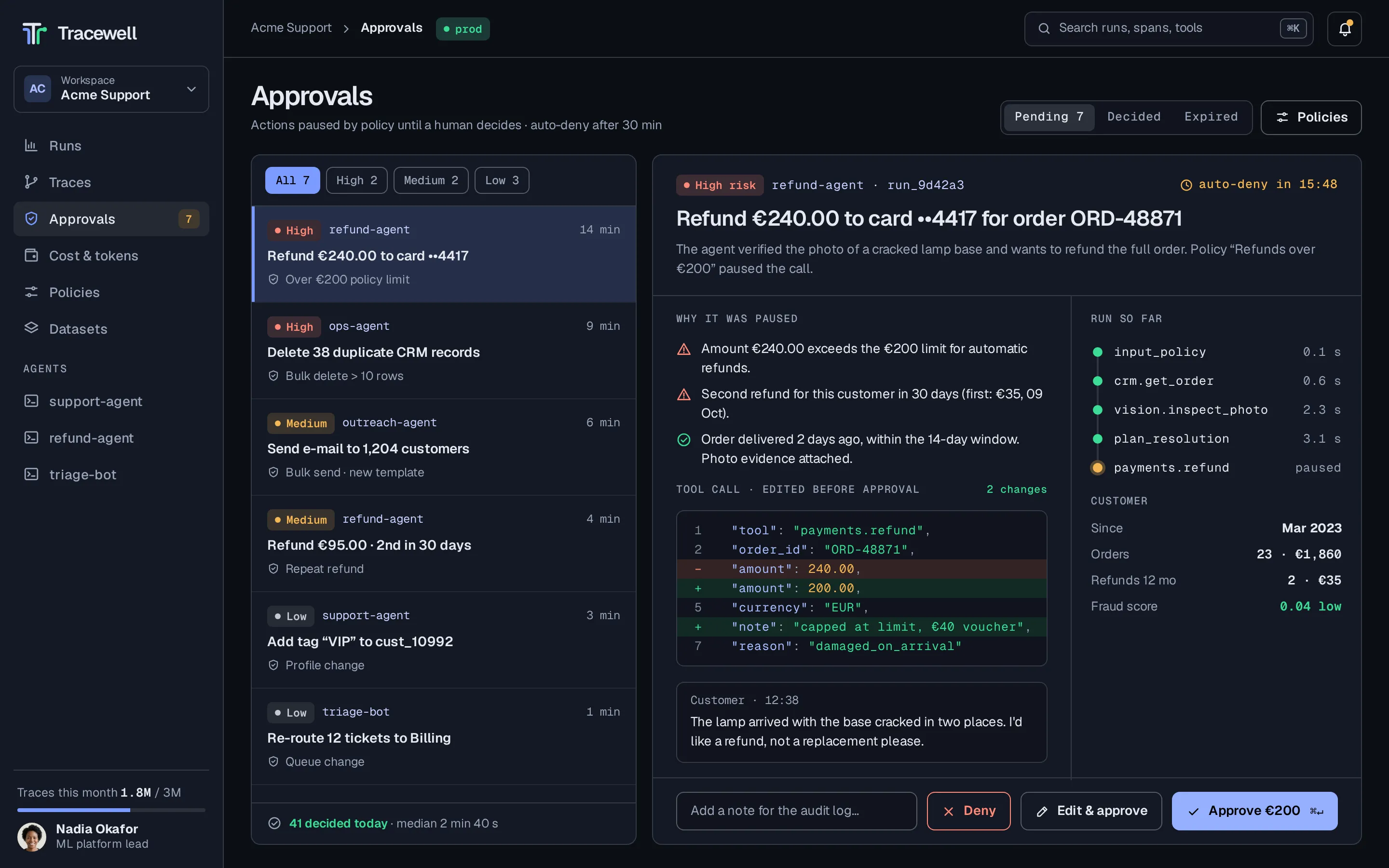
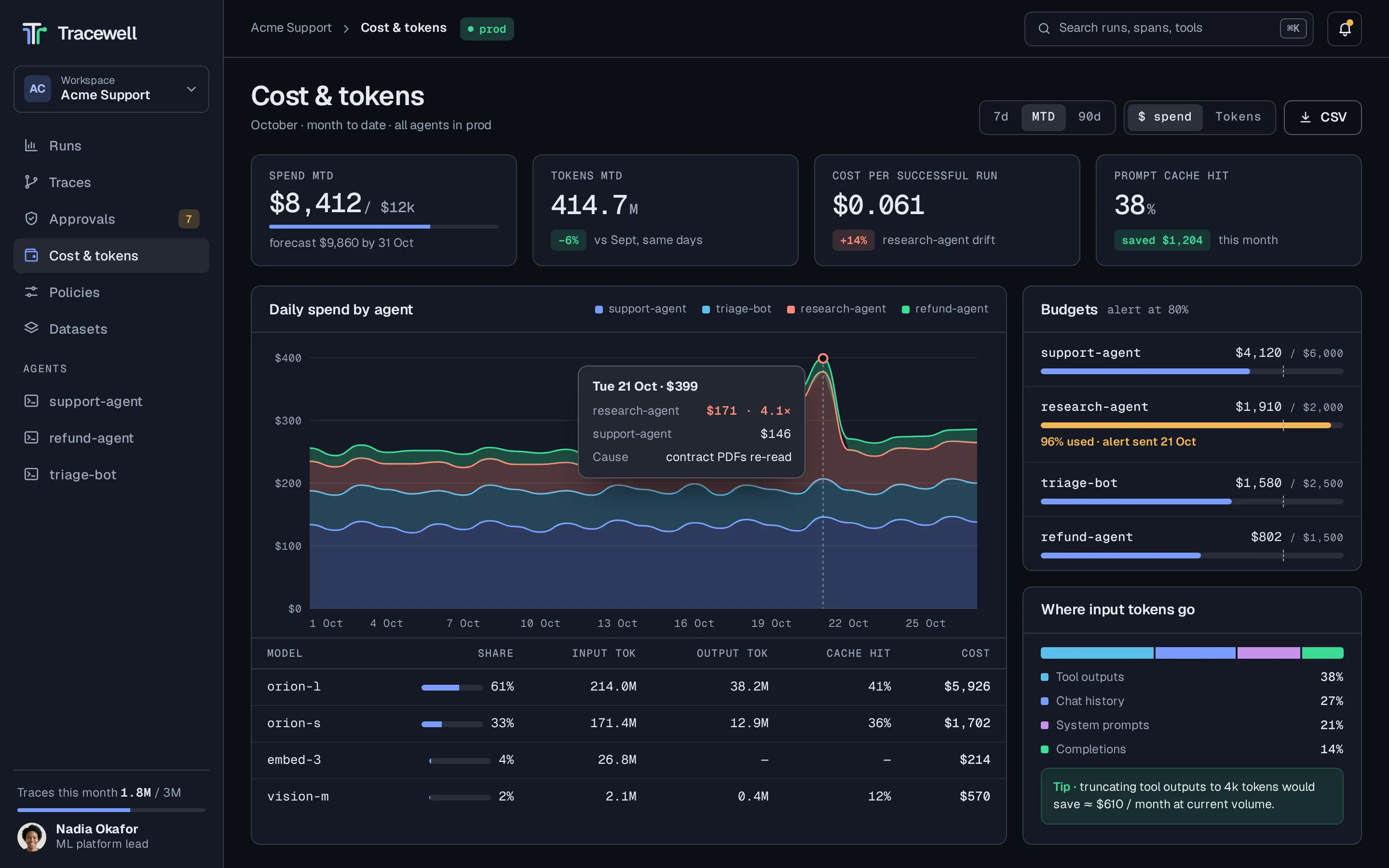
Passed / failed / running / awaiting approval runs, collapsed and expanded spans, a 422 error with a diff, a pending approval with a countdown, a budget at 96%.
- 04
Assets
Two backdrop renders made for the concept — a dark bokeh behind the glass overview and a marketing hero for the sheet cover. The dense screens use none.
- 05
Glass, measured
Night glass at 70% with 36 px blur; muted text raised to #BCC4D4 on glass because the palette's steel dropped to 3.1:1 over the green glow. Worst pixel: 5.62:1.
- 06
Real-looking data
Run ids, span timings, token counts, a postcode with a trailing space as the bug and a €240 refund capped at €200 — the layout is tested by real lengths.
A dark lab where only signals glow.
Void and panel greys carry the content; signal blue marks actions and selection (7.4:1 on void), pass green is the only success colour (10.9:1). Geist sets the interface, Geist Mono every id, token and timing.
A «T» made of parallel traces — a horizontal and a stem, a blue trace beside them and a green branch ending in a node: a trace tree at 16 px. Picked from four sketched directions.
#7C9CFF
vs bg 7.41:1 · label 8.06:1
#3DDC97
on bg 10.93:1
#E6E9F2
on bg 15.92:1
#0B0E14
text on it 15.92:1
#141925
text on it 14.47:1
#9AA3B8
on bg 7.64:1
Accent / bg 10.9:1 — pass green is bright enough for text and icons on the dark canvas; it is still kept for success states only.
Geist 600Tracewell
Geist 600AI/ML engineers, ops and product owners running agents in production
Geist Mono 400 · 16/26Mission control for AI agents: replay every run as a step-by-step trace, catch cost spikes and failures, and approve risky actions before they execute.
Geist Mono 600 · 12AI tools / agent observability
Four screens between a failed run and a signed-off refund.
Runs overview · glass
Glass sidebar, top bar and KPI tiles with sparklines over the backdrop; the recent-runs table with a failed run on hover, anomalies and outcomes per hour.
Trace tree + waterfall
Span type, name, bar and time on one row; the failing branch stays expanded.
Edited tool call
A human edit is shown as a diff — 240.00 becomes 200.00 — next to why the run paused.
Trace replay
The failed run as a tree of spans with a waterfall, the selected span with its 422 error and request diff, and a scrubber to replay it step by step.
Approval queue
Actions paused by policy, sorted by risk: why it was paused, the tool call edited before approval, the customer's words, Deny / Edit & approve / Approve.
Cost & tokens
Spend by agent across October with the spike on the 21st explained, a model table, budgets with one at 96% and where input tokens go.
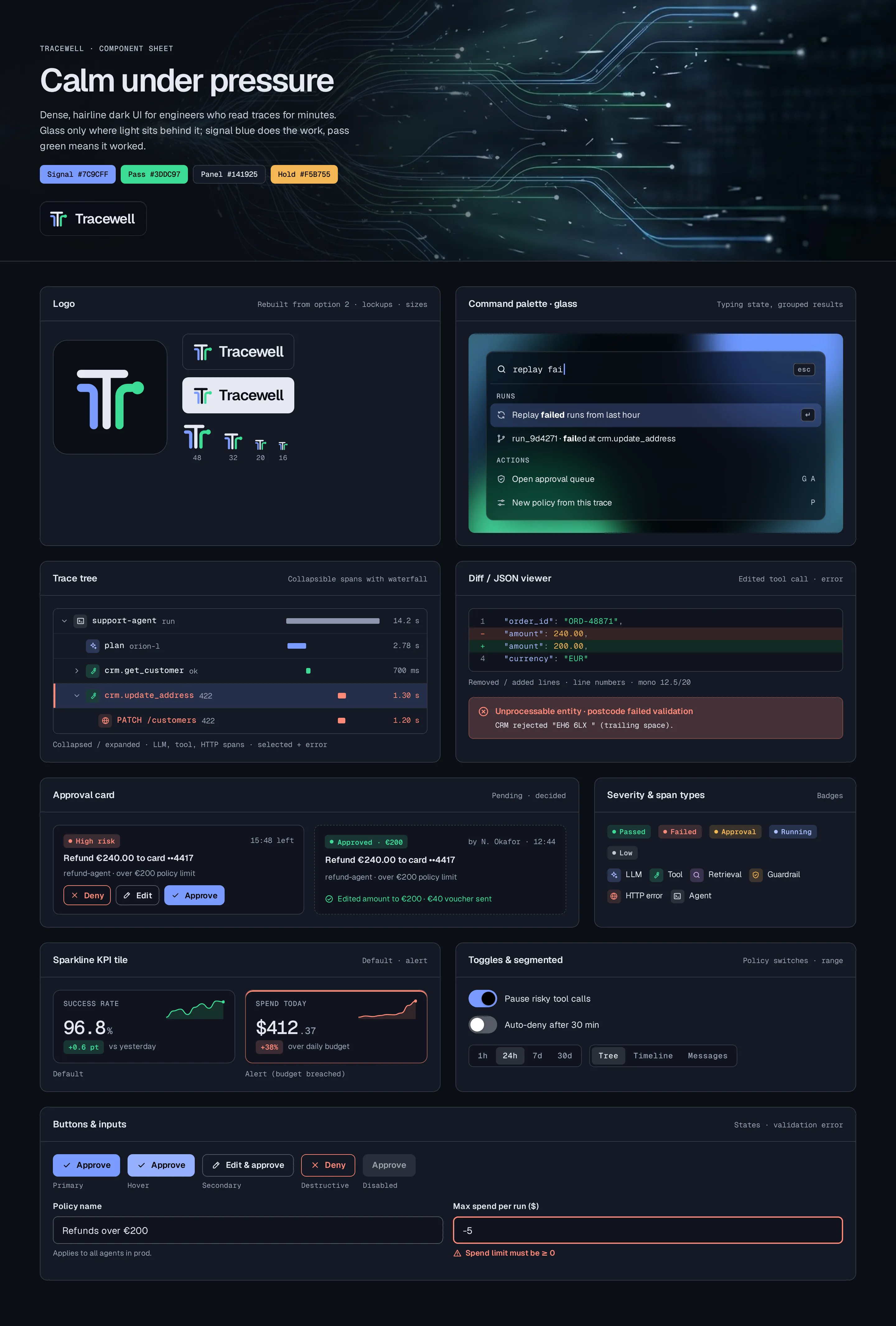
Component sheet
Cover with a glass lockup, logo, command palette on glass, trace tree, diff / JSON viewer with error, approval card (pending / decided), severity and span badges, KPI tile (default / alert), toggles, segmented control, buttons and inputs with error.
PreciseDark-labCalm
Questions & answers
Is Tracewell a real product?
No. Tracewell is a self-initiated concept by Omnisense — a brief we set ourselves, with no client and no business metrics. All agents, runs, customers and costs in the screens are sample data, and the models shown are fictional.
Who is Tracewell for?
AI and ML engineers who debug agents, ops people who watch them, and product owners who answer for their cost and their mistakes.
What did you design?
A dark desktop console for AI agents in production: a runs overview with KPIs and anomalies, a trace replay of a failed run, an approval queue for paused actions, and cost & token analytics with budgets.
How does the approval queue work?
Risky actions pause before they execute and wait for a human. Each item explains why it was paused, and a countdown shows when it will be denied automatically.
Do you need to be an engineer to read it?
No. The audience is broad, so labels stay plain — «Failed at step 6», «Why it was paused» — and the engineering detail lives one click deeper.